CATS


TL;DR
CATS is an integration testing suite that extends Pytest with custom protocols for communicating with and controlling a particular model of MAS radio. Its primary goal is to reduce the risk of firmware regressions inherent to the radio’s rolling-release model; furthermore, CATS aims to enforce more thorough testing as part of our software process through the use of GitLab CI pipelines, which ensure that merge requests are validated before allowing them to be accepted. Before CATS’s implementation, many integration tests were performed manually once a new release candidate was ready to be validated. In addition to being time-consuming, this method only tested the radio’s firmware when making new releases, giving regressions the opportunity to emerge between releases without an efficient way to identify their origin. Although rollout progressed more slowly than expected, CATS has proven to be a useful tool in practice. It has reduced the per-release firmware validation time by more than an hour and has been used to validate several firmware versions. As my first major project during my internship, CATS provided much experience in the realm of test automation, CI pipeline development, embedded systems, and working to improving our team’s overall software process.
Background
The Need for CATS
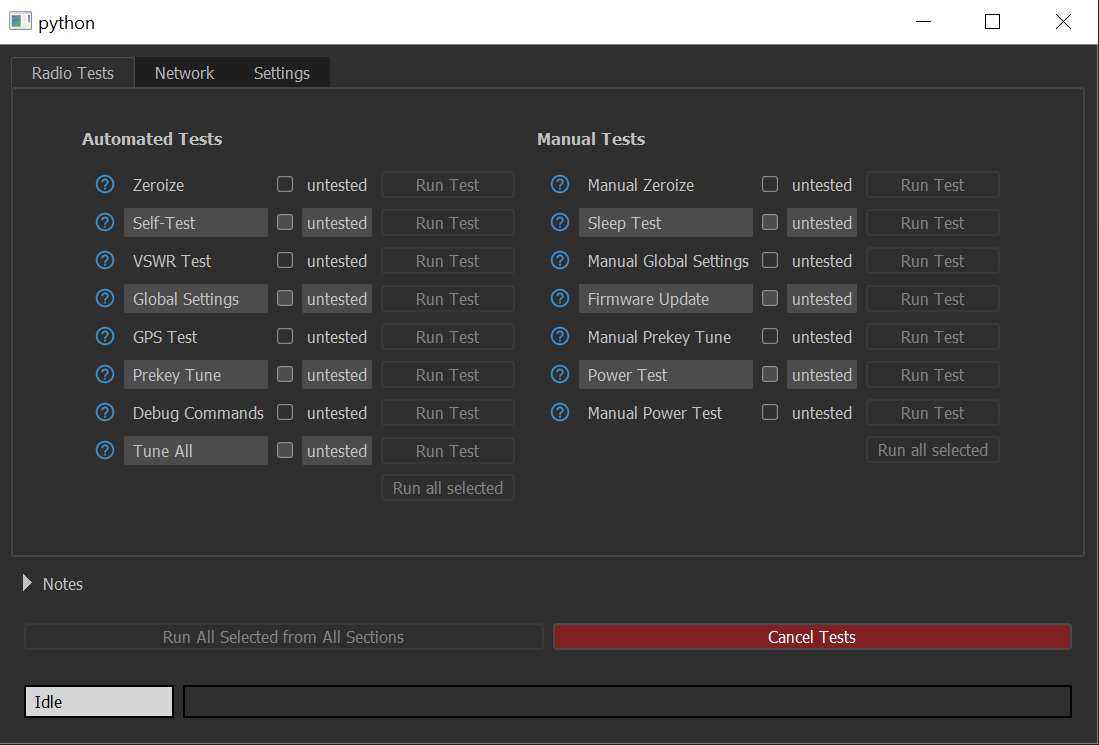
When I arrived at MAS, testing radio firmware relied heavily on BTS, an existing tool that required engineers to manually run tests and monitor results. While BTS provided some assistance in the testing process, its workflow still demanded a lot of human involvement, and the radio’s codebase would only get validated when a release candidate was ready.
A screenshot of the BTS testing software.
With bugs and regressions accumulating in the radio’s firmware, it became clear both the testing software and process involved in validating new releases needed improvement. The solution devised by the engineers at MAS was to make a new integration testing suite to automate firmware validation, with the added benefit of enabling these tests to be run automatically as part of merge requests through GitLab CI. My role was to get such software into a finished and deployed state, and that is what I set out to do with CATS.
The Testing Pyramid
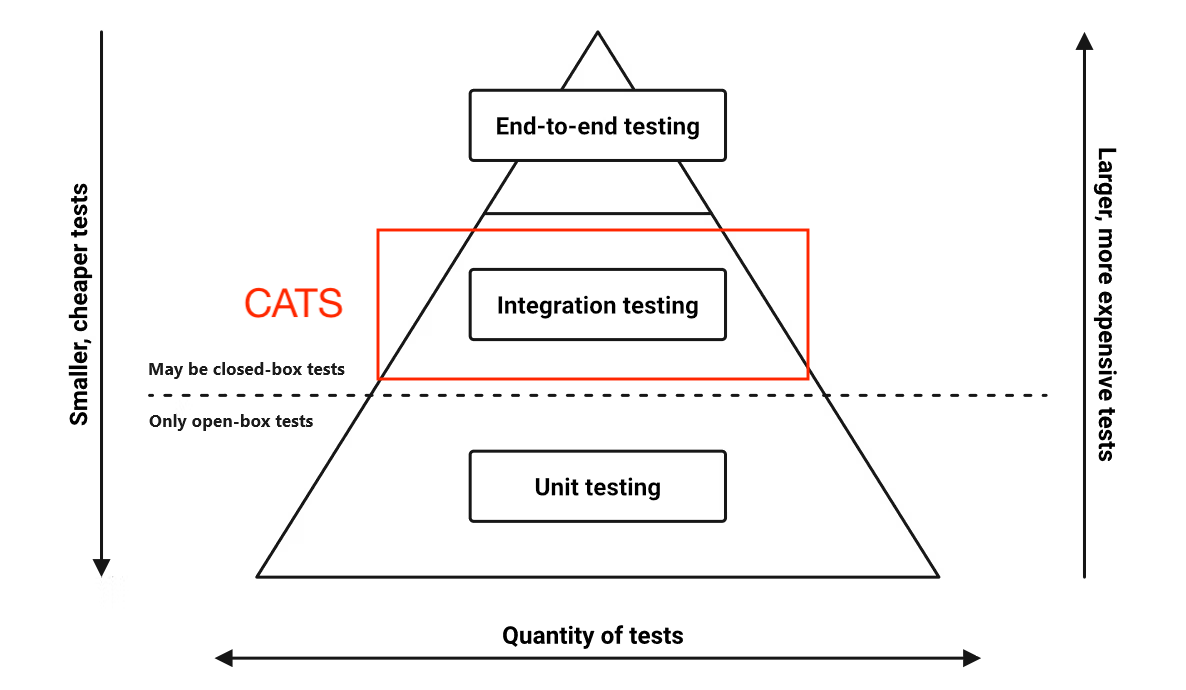
CATS also addresses a broader goal at MAS: ensuring comprehensive coverage across all layers of the radio firmware testing pyramid. Specifically, CATS aims to tackle the integration testing layer of this pyramid, as detailed by the diagram below:
Functionality
CATS is an integration testing suite built on Pytest that implements the following functionality:
Communication with the Radio
CATS can communicate with the radios over IPC, IP, and serial connections. Custom protocols allow sending and receiving messages, storing them for later analysis, and automatically asserting test success or failure depending on whether expected messages are received.
Automatic Assertions
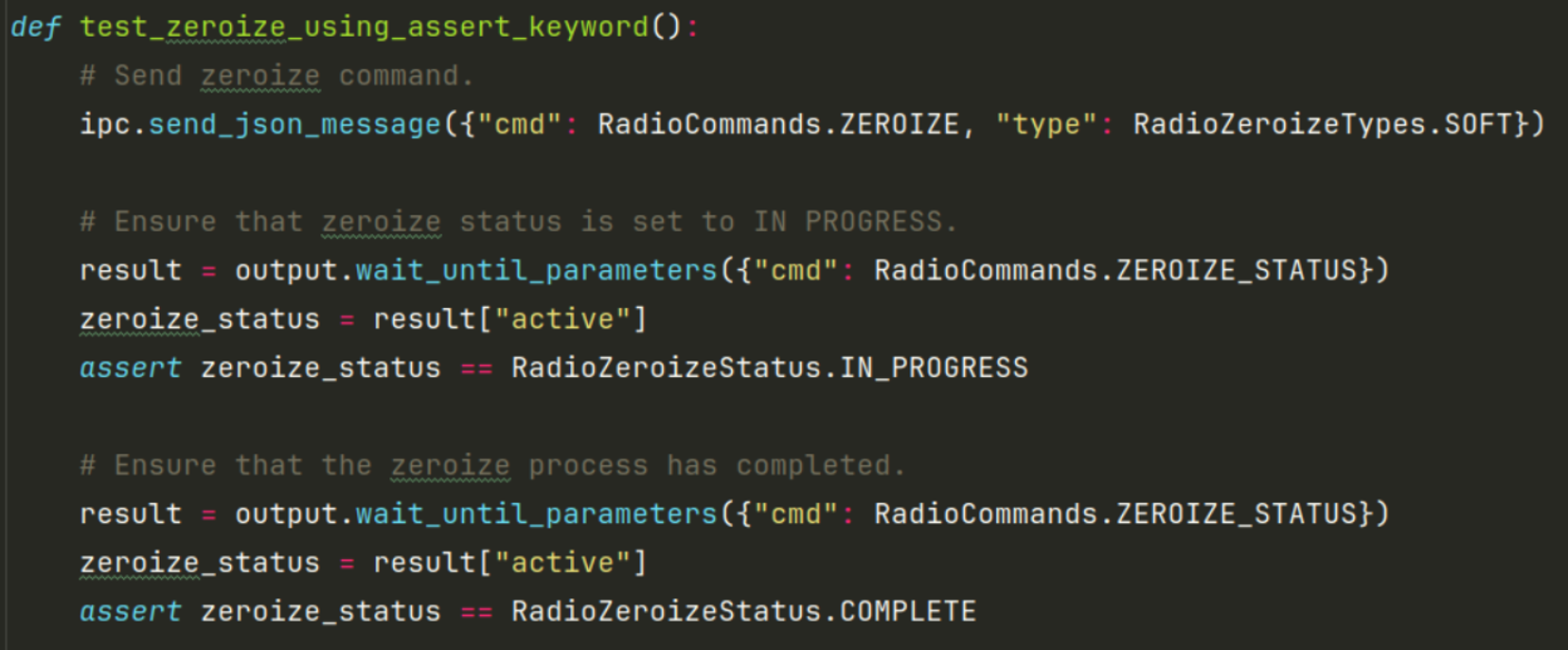
Users specify output the radio is expected to respond with after an action is performed, along with a timeout interval; if the expected output does not appear, CATS automatically fails the test and continues to the next one.

By avoiding assert statements when possible, CATS reduces code, saves development time, adheres to DRY principles, and minimizes potential errors.
Code snippets showing example test code both without (top) and with automatic assertions (bottom); take note of how much the automatic assertions have simplified the code.

Customizable Logging
CATS leverages Python’s logging module, as well as Pytest’s logging capabilities to produce detailed logs. Output can
be customized in the CLI using custom arguments, and log files that capture all log messages are automatically
generated, including those not shown in the CLI.
A screenshot showing CATS’s log output in its most condensed form:
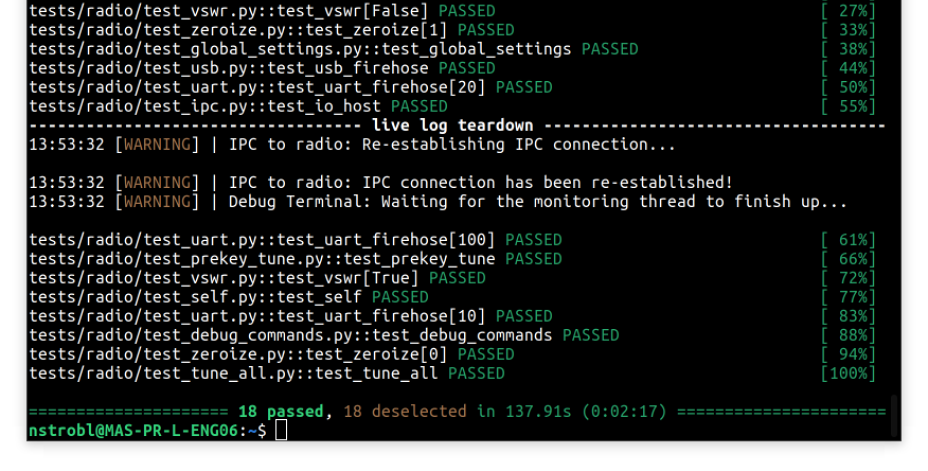
CATS’s CLI arguments for changing logging options.


Test Filtering and Organization
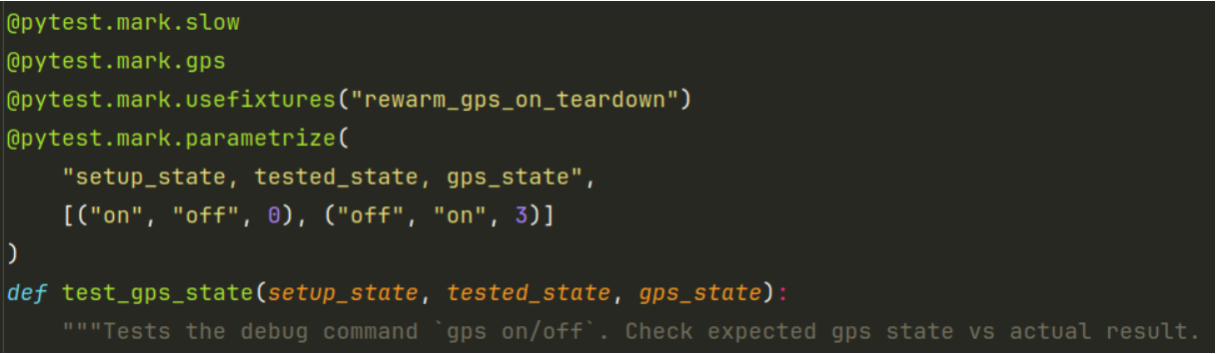
Using Pytest markers, CATS organizes and filters tests efficiently. Markers can be added to tests via decorators, and
the available set of markers can be customized using the pytest.ini file. This feature allows developers to only run a
subset of tests and categorize the functionality of tests, maintaining a clean test structure.
Code snippet showing markers being applied to a test function.
Marker definitions in
pytest.ini.

Radio Firmware Updates
CATS can perform firmware upgrades on a radio if a firmware update file is provided. During the procedure, all radio output is captured and logged, especially firmware update status messages.
Simplified Distribution via Docker
CATS is distributed as a Docker image containing Python and radio firmware libraries; this is done to simplify deployment across environments and ensure consistency between running CATS via the GitLab CI pipeline and running it locally on development machines. The benefits over choosing Docker instead of something like PyInstaller are detailed more in this section of the post.
Impacts of this Software
Beyond its technical capabilities, CATS has had a positive impact on how radio firmware is developed, tested, and validated at MAS. By integrating automated testing into both local development workflows and CI pipelines, CATS enables radio firmware to be tested continuously, from early development all the way to distribution. The following sections elaborate on the various ways CATS has influenced MAS’s radio firmware development process:
Test-Driven Development
CATS’s biggest strength is enabling developers to adopt test-driven development practices for radio firmware. Using Docker, developers can run CATS locally on their development machines, mounting their local version of the radio firmware codebase at runtime; this allows tests to be written and executed on a separate branch without needing to repackage CATS for every change, providing fast and iterative feedback that assists in ensuring new features behave correctly from the start.
Protecting the master Branch
By integrating CATS into GitLab CI pipelines, the master branch of the radio firmware codebase is protected from
untested or faulty code. Merge requests cannot be accepted until new code is validated with CATS, meaning any changes
that cause existing tests to fail must be investigated and resolved before merging. This enforces testing as an integral
part of the firmware development workflow, reducing time spent debugging regressions later.
Catching Regressions Early
CATS also runs a nightly pipeline that executes the most up-to-date firmware against a comprehensive test suite; these tests are more extensive than those required for merge requests, requiring several hours to complete. Running these slower, more complex tests only during the nightly pipeline run balances rapid feedback for developers during active development while still catching regressions early enough that they don’t escalate into larger problems.
Retrospective
Overall, I’d say CATS has been a useful tool for automating the process of radio firmware validation and promoting test-driven development practices within the team. Although the rollout of merge request pipelines has progressed more slowly than I initially hoped, developers are gradually incorporating CATS into their daily workflows, and the system has already uncovered several firmware bugs that have led to fixes. As my first major project done in a professional setting, I gained hands-on experience not only in test automation, setting up CI pipelines, and the process of producing embedded software, but also in the soft skills necessary to deliver a new software project that meets developer needs and guide a team of software engineers into adopting it. I am looking forward to seeing what else I can learn and accomplish during my time at MAS.